
Imperialism, self-determination, and the latest stage of the war on Iran

Matt N. also contributed research for this piece
With the recent U.S. attack on Iran and the unfolding war, socialists in the U.S. are faced with how to respond as anti-imperialists within the imperial core. What the Trump administration had hoped would be a short regime change operation akin to the kidnapping of Nicolás Maduro has quickly devolved into a regional skirmish with numerous casualties and global economic impacts. In making meaning of this conflict, as well as the period of protest and lengthy escalation of international provocation that led up to it, the question of self-determination for Iranians is being debated by the left in the West. This is often invoked to muddy the waters around the conflict and create an opening for tacit support for “regime change” from the left. Criticisms levied at Iran from the left are often predicated on the fact that the Iranian state is neither socialist nor liberal. However, by looking at the long history of U.S.-Iran relations, and insisting on a socialist framing of self-determination, we see that Iran’s opposition to imperialism is foundational to the self-determination of the Iranian people. So we should clarify what is meant by self-determination, for who it is fought, and in relation to whom or what.
Imperialism: The Primary Contradiction
As Marxists, we understand society to be defined by class conflict between exploiters and the exploited; oppressors and the oppressed. Generally, this conflict exists between the working class and the capitalist class. But Lenin's Imperialism, and the many great works of political economy that followed in its tracks, showed that this oppression has international dimensions. As an outgrowth of domestic class antagonism, there are class antagonisms beyond national boundaries, between exploiter nations and exploited nations. This forms the backbone of the globalized capitalist system, with the U.S. and its Western allies, the imperial core, as the global exploiters.
In this globalized capitalist system, a country’s national bourgeoisie may be extracting profits from the exploitation of its own domestic working class, and using its state apparatus to oppress that working class. But internationally, the imperial core extracts superprofits from entire nations, using its military and financial apparatuses to oppress nations of the imperial periphery. In Lenin’s 1916 essay Imperialism and the Split in Socialism, he explains superprofits thusly:
A handful of wealthy countries—there are only four of them, if we mean independent, really gigantic, “modern” wealth: England, France, the United States and Germany — have developed monopoly to vast proportions, they obtain superprofits running into hundreds, if not thousands, of millions, they “ride on the backs” of hundreds and hundreds of millions of people in other countries and fight among themselves for the division of the particularly rich, particularly fat and particularly easy spoils.
Torkil Lauesen, in Unequal Exchange: Past, Present, and Future, argues that superexploitation has intensified over the 20th century in the age of globalization:
Today, international trade is not just an exchange of commodities produced by capitalist firms in different countries, as was primarily the case when [Arghiri] Emmanuel formulated his thesis in 1969. With the globalization of production in the form of outsourcing and transnational productions chains, the controlling “brand-firm” located in the Global North, gets a higher profit rate than the producing firms further along the chain in the Global South. In this case, the inequality of exchange not only is not reduced but is in fact aggravated, since the Global North “charges” its sales not only with its super-wages but also with its superprofits. (2025, p. 47)
The imperialists’ ability to extract the wealth of entire nations far outstrips the ability of domestic capitalist classes in the global south to extract from their own working classes. Correspondingly, the brutality inflicted by imperialist violence, from colonial occupations and military operations to predatory loans and crippling sanctions, often outstrips domestic conflicts. The contradiction between the capitalist class and working class of a single nation is superseded by the contradiction between the global imperialist class and the entire exploited nation. Imperialism, then, becomes the primary contradiction faced by that nation—the contradiction that shapes all other conflicts, and which must be resolved before others can be fully addressed.
This dynamic was clear in many of the national liberation movements of the 20th century. These movements were often composed of various working-class and socialist elements, but also of reactionary elements and the national capitalist classes. Against imperialism, these classes were forced into collaboration against the greater threat of imperialism. We categorize movements such as these as historically progressive—acts and actors that resolve contradictions and move the progress of history forward. In the case of national liberation movements, they constitute the progressive force in the struggle against imperialism; therefore, despite their heterogenous political composition, they represent historical progress.
We see this also in Palestine. The forces resisting Israel’s genocide are a mixed bag politically, but they’ve united in their opposition to imperialism, which in their case takes the form of settler colonialism and apartheid. Right now, that is the primary contradiction within their nation; the contradictions within their domestic politics are superseded by their struggle for national liberation. It was a lesson it took the U.S. left time to learn; for the first several months of the genocide, it was near-impossible to express support for the Palestinian resistance without conditioning that support on a condemnation of Hamas, the leaders of the resistance. But we’ve come to understand that for any sort of socialist movement in Palestine to take root, the primary contradiction of imperialism must first be resolved, and in this, Hamas are not the enemies of the Palestinian working class, but allies.
Imperialist interference in Iran
In Iran, we’re faced with a similar dynamic. Through a history of CIA-orchestrated coups and proxy wars over oil interests, the U.S. has long been a party to conflict in Iran. Most directly, the 1953 CIA-backed coup against Mosaddegh is a moment that is recognized by the U.S. left as an imperialist intervention into the sovereignty of Iran in favor of monarchy and oil interests. But even beyond that very obvious example of imperialism, the U.S. and Israel deeply embedded their interests in the Shah’s government post-1953, notably via the establishment of the secret police, SAVAK, which both the CIA and Israeli intelligence played a key role in creating. While the Islamic Republic that grew out of the 1979 revolution is not socialist, it did grow out of a genuinely popular social revolution where the Iranian people self-consciously freed themselves from the oppression of Zionism and U.S. imperialism. This historical context is key to understanding how the Republic plays a historically progressive role in the fight against Zionism and imperialism.[1]
The U.S. has long sought to overthrow the Iranian Republic and install a vassal state in its place. During the “war on terror”, elected officials openly fantasized about drawing Iran into the conflict on the flimsiest of premises. The U.S. has also set up a draconian and punishing sanctions regime against Iran, which has sought to cut Iran off from the rest of the world economically for decades. Iran’s supposed nuclear program has been the main justification for these sanctions since the mid-2000s – but Israel, the U.S.’s ally, has never received so much as a slap on the wrist for its policy of “nuclear opacity.” So for more than 70 years now, the U.S. has been undermining, threatening, and subverting the sovereignty of Iran and its people – an undoubtedly imperialist situation, where the cost of not submitting to the dominance of Western capital is exacted on every man, woman, and child in Iran.
SAVAK, and the Shah’s regime generally, was a deadly anti-communist force to counterbalance the Soviet Union and China, and the crackdown on communist elements lead to the shallowness and division of the Iranian left at the time when the contradictions within Iranian society reached a point where revolution became inevitable in 1978. This lack of an organized Iranian socialist front meant that the social revolution that broke out became organized by traditional power centers of Iranian society — clerics, allied with the small merchant class — instead of by a revolutionary socialist party as in the Russian revolution. ↩︎
The U.S. and Israel expand their attacks
Israel, with U.S. support, has been engaged in both overt and covert operations against Iran since last June. During the “Twelve Day War” in June 2025, Israel bombed several energy facilities, supported by Mossad infiltrators and saboteurs who assassinated numerous military officials and nuclear scientists, including IRGC officer and Chief of the General Staff of the Iranian Armed Forces Mohammad Bagheri. The U.S. imposed a ceasefire, which was immediately broken by Israel. Then, on September 28, 2025, UN sanctions were re-imposed on Iran via a “snapback” clause in Iran’s 2015 nuclear agreement, despite resistance from China and Russia. These sanctions devalued the Iranian rial, causing widespread pressure on the prices of basic foodstuffs, which were skyrocketing in price beyond the general inflation Iranians experienced. This led to protests as traders and merchants clashed with riot police in Tehran’s historic Grand Bazaar. As protests continued, Iranian President Masoud Pezeshkian met with protest leaders to hear their grievances, and the chief of Iran’s bank resigned. Iranians faced the end of 2025 more poor, hungry, and desperate than ever.
In the new year, the U.S. added fuel to the flames it had been stoking. On January 2nd, former U.S. Secretary of State Mike Pompeo cryptically wished a “Happy New Year to every Iranian in the streets. Also to every Mossad agent walking beside them…” Less than a week later, on January 8th and hours after Kurdish political parties organized mass strikes, Reza Pahlavi, son of the deposed former U.S.-backed Shah and opposition figurehead, called for a mass day of action. Israeli Heritage Minister Amichai Eliyahu later seemed to confirm Pompeo’s boasting, saying Mossad agents were working to foment unrest in Iran, contributing to cyberwarfare attacks and admitting it was directly linked to the June 2025 bombing campaign. In response to these events, the Iranian government in short order imposed an internet blackout. The Financial Times reported testimonials of Iranian citizens, smuggled out from underneath the government-imposed blackout of January 8th, that “reveal[ed] a muddied account of the turmoil itself, in which agitators mingled with genuine protesters.” The playbook is as clear: impose sanctions to create domestic unrest, and heat up that unrest through agents provocateurs. This is the logic of the ultimately bipartisan campaign against Iran—decades of slow strangulation, priming the political situation for the right moment. On the heels of a military operation against Venezuela that has set off a domino effect in Latin America, the Trump administration has decided that its moment has come.
Self-determination
The crisis facing Iran is entirely the consequence of three-quarters of a century of imperialism. In this context, how should we speak of self-determination? When debating imperialism, the idea of self-determination is often invoked in a third-campist manner (“neither Washington nor Moscow/Beijing/Tehran, but the international working class!”) to establish a distinction between people and their government. The same thing is happening now—the question of “self-determination” is invoked here to cast the Iranian people as a third player in the current moment, between the Iranian state and the U.S. and its proxies.
But beyond Iran, the concept of self-determination deserves interrogation. In the 20th century, self-determination was formulated in subtly different ways by socialists (Lenin, Luxemburg), national liberation movements, and liberal imperialists (Woodrow Wilson). The liberal, Wilsonian concept of self-determination relied on an idealist—and racially-determined—definition of “nation” as being a people who shared a common language, history, culture, genetics, and above all a geographically well-defined homeland, and asserted the right of self-determination to mean that every nation must have their own state. This Wilsonian liberal formulation was consciously designed to undermine the U.S.’ European imperial rivals by stoking nationalist movements within their own domains, while at the same time the demands of the former colonies were rejected or ignored. This liberal weaponization of nationalism to undermine enemies of the U.S. lives on in the propaganda efforts of the State Department and other imperial institutions to undermine its enemy states from within.
The key difference between the socialist and liberal formulations behind the same word is the definition of the people. Lenin’s definition of self-determination is inseparable from imperialism and applies to the people of the periphery, i.e. people whose class position is defined by a subaltern relationship to empire. The people are defined by their shared struggle against imperialism. In order to assess whether in any concrete case self-determination supports or undermines empire, we must first ask who are the people in question and from whom or what power are they seceding.
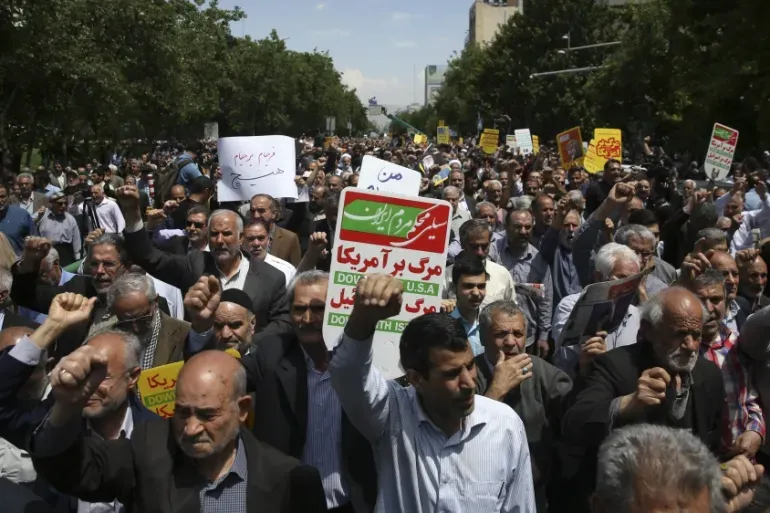
The 1979 revolution established sovereignty for Iran, casting off the client-state yoke of western imperialism. It did this by creating a social and economic basis for political and national self-determination. The western imperialist powers sought to undermine this basis ever since. Today, U.S.-led sanctions have crippled Iran’s economy for decades. Domestic class contradictions have become overpowered, and the self-determination of the country against imperialism continues to be the core contradiction facing the country. Since the U.S. and Israel began their most recent bombing campaign, the protest movements in Iran have disappeared. Instead, there have been several rallies against the imperialist war and in support of the Iranian government, with many joining behind the government as they defend the country from attack. Here, we can see that despite domestic conflict surfacing as a contradiction, it is not the primary contradiction—it has been superseded by imperialist conflict.
For us in the imperial core, how can we support Iranian self-determination? Can we support the self-determination of a people against their own government? Perhaps not directly, and not at a time when the primary contradiction facing Iran is one involving the attacks from our own government. With Palestine, we support the self-determination of the nation against U.S.-backed Zionist occupation; and just the same, we support the self-determination of Iran against U.S. imperialism.
Socialists in the U.S. should understand that it is not in our interest to stand, in the final analysis, alongside the military-industrial complex, state department, and global finance capital—not to mention California water barons and evangelical Christian fanatics—as they demonize Iran in order to justify naked imperialist meddling. Rather, we need to play our part in resolving the primary contradiction of U.S. imperialism and confront the warmongering imperialist ruling class at home that has been strangling Iran for not days but decades. The American-made bombs being dropped on schools and chemical warfare being waged on Iranians by the millions are not an aberration, but rather a grim portent of what is to come in the 21st century if we cannot see clearly which side we should be on when oppressed nations resist imperialism.
Further Discussion
If you're interested in discussing this piece with other DSA members, head on over to the DSA Discussion Board.
The forums are open to all DSA members in good standing. If you're not a DSA member in good standing, sign up or renew your dues here.