
In Defense of Abolition
Hazel W. makes the Marxist case for abolition against the left's growing accommodation to policing and prisons.
At the July NPC meeting Red Star proposed adding abolition to the Workers Deserve More program because we believe the abolition of capitalist policing and prisons is a fundamental demand of the socialist movement.[1] We crafted the language carefully in order to clarify that we mean abolishing policing and prisons as institutions of capitalist rule, not conflating the abolition of capitalist policing and prisons with the abolition of every future social capacity for accountability and safety.
Our amendment was opposed by the Socialist Majority and Groundwork caucuses. Soon after the program’s launch, the abolition plank came under criticism from some DSA members, and several endorsed electeds explicitly disavowed the demand. Here, we argue that these reactions are rooted in a misunderstanding of the socialist tradition of abolition, a misreading of the lessons of 2020, and ultimately serve a reformist, anti-revolutionary conclusion.
Abolition and Marxism
Underlying the current debate over abolition are two recurring misunderstandings. The first, common among liberals and reformists, conflates the abolition of capitalist policing and prisons with the abolition of any future capacity for collective safety, accountability or restraint. The second, more common in anarchist traditions, rejects the Marxist understanding of the state itself. Marxists reject both errors by analyzing policing and prisons as institutions produced historically by particular class relations rather than timeless expressions of coercion. Resolving both misunderstandings requires a historical materialist theory of the state and its carceral institutions. A Marxist analysis asks the questions: What social relations produced this institution? What class function does it perform? What material conditions make it necessary?
The Liberal / Reformist Error
Marxism differs from liberalism on the question of the state. Liberalism views the state as an essentially neutral instrument that can be put to different purposes. Marxism instead asks what class relations produced particular institutions, what functions they serve within those relations, and how they can be transformed and the material conditions of society changed.
If, after the revolution, we have socialized the means of production, broken the profoundly corrupting ideological and cultural grip of capitalism, reimagined healthcare, housing, education, social services, and our communities around human need, what will we do with the rare person who remains hellbent on committing violence? Might we provide them with as much care and as many resources as we can while ensuring they are separated from the people they intend to hurt? It is absurd for a Marxist to equate revolutionary institutions of safety, accountability, and care with the institution of policing and prisons under capitalism, or to abandon abolition as a rallying call. Demanding otherwise is akin to asking a DSA candidate to specify how many children it’s okay for immigrants to assault to justify our position on borders. The possibilities of harm under any social arrangement does not establish the necessity of the institutions through which capitalist society currently manages it. Our task is to abolish those institutions and transform the social conditions that reproduce violence, not promise that socialism will make every violent act impossible.
A related argument for “carceral minimalism” by Loïc Wacquant and more recently Paul Heideman in Jacobin posits that abolition is not a viable path to social justice. Wacquant is explicit that he understands abolition to entail eliminating the “triad” of police, courts, and prisons rather than merely shrinking or reforming them. He correctly argues that we must take victims’ safety seriously and fight to materially reduce incarceration and state violence under existing conditions, but his framework never escapes a liberal capitalist horizon. The question he poses is how policing, courts, and prisons can be made more limited and humane under capitalism, not whether the social relations that produce and sustain these institutions can be overcome. Indeed, his piece doesn’t mention socialism or communism a single time. The persistence of violence therefore becomes a reason to preserve some version of the institutions through which capitalist society currently manages it. A Marxist abolition rejects this inference and seeks to transform the material conditions that reproduce violence while developing new, democratically controlled capacities for collective safety, accountability, and repair. A socialist society might, where absolutely necessary, separate people who are a danger to others while providing them with care. But Wacquant’s insistence that a penal state as a specialized apparatus of class domination as we know it is a permanent requirement of complex society mistakes a historically specific institution of class rule with a universal social necessity. His “carceral minimalism" ultimately offers a program for managing coercion from within liberal capitalism, not a socialist alternative to it.
The Anarchist Error
Where the liberal error conflates abolition of policing with the abolition of all social accountability, the anarchist error mistakes the Marxist theory of the state for a defense of the capitalist state itself, locating the root of oppression primarily in hierarchy, bureaucracy, and coercion rather than the class relations that give the state and its instruments their political character.
Lenin outlines his conception of the state in The State and Revolution. He writes that “the state is a product and a manifestation of the irreconcilability of class antagonisms.” It arises when society becomes divided into antagonistic classes. Here, Lenin quotes Engels, who writes that the state “becomes a power seemingly standing above society,” a “special, public power” that “does not directly coincide” with the people, consisting of “special bodies of armed men”, and “a standing army and police” as “the chief instruments of state power.”
The significance of this analysis is that Lenin does not define the state or policing merely as a form of coercion, but as the product and a manifestation of the irreconcilability of class antagonisms. The capitalist state is an organ of capitalist rule produced by class society and used by the capitalist class to maintain its domination. The police serve as one of its chief instruments.
The proletarian state exists to defend the revolution against capitalist counterrevolution while creating the material conditions for its own obsolescence. As class antagonisms are overcome, coercive institutions produced by class antagonisms lose their social basis. Some critics of abolition correctly identify this need to defend the revolution, but both fail to understand the difference in political character of coercion under socialism and fail to envision a world beyond class antagonism. This is ultimately an anti-communist perspective.
Marx’s analysis of the Paris Commune in The Civil War in France makes this distinction concrete. He argues “the working class cannot simply lay hold of the ready-made state machinery, and wield it for its own purposes,” specifically identifying the standing army, police, and bureaucracy. Marx praises the commune because it “got rid” of these institutions and transferred their functions to serve the working class, rather than simply inheriting them:
“Instead of continuing to be the agent of the Central Government, the police was at once stripped of its political attributes, and turned into the responsible, and at all times revocable, agent of the Commune…having once got rid of the standing army and the police – the physical force elements of the old government.”
He continues:
“Wonderful, indeed, was the change the Commune had wrought in Paris! No more corpses at the morgue, no nocturnal burglaries, scarcely any robberies; in fact, for the first time since the days of February 1848, the streets of Paris were safe, and that without any police of any kind.”
This is the materialist basis for a socialist abolitionism. We seek the abolition of prisons and policing as institutions of capitalist domination, while recognizing that socialism will have to solve real problems that capitalism currently purports to address through those institutions. The Marxist question is not whether those problems exist nor whether society may ever require coercive measures, but what social relations make particular forms of coercion necessary, who controls them, what class interest they serve, and how the institutions reproduce the conditions that make them necessary.
In this way, abolition is not a demand to abolish social protection or accountability, but a demand to abolish the capitalist form through which these problems are organized, and to transform the underlying social conditions so that institutions of class domination are unnecessary.
The Rise of Abolition
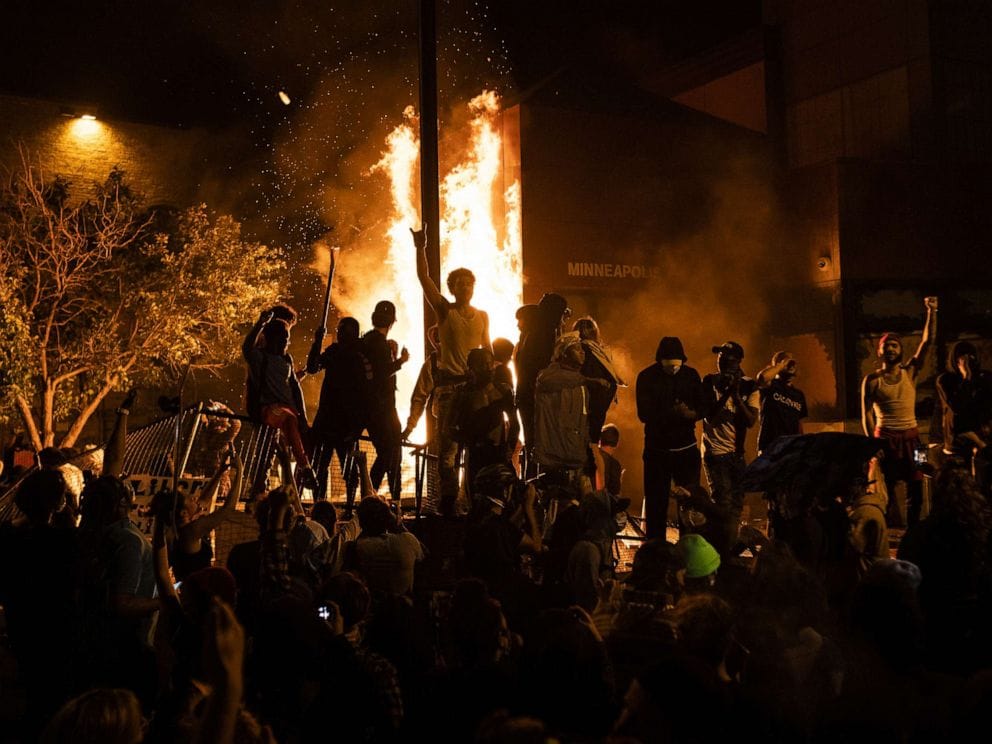
During the George Floyd uprisings in 2020 abolition was a central concern in socialist politics. At its strongest, the movement came to understand abolition as not only a moral appeal against punishment in the abstract, but a fight against police and prisons as institutions rooted in the history of slavery, racial capitalism, and class rule, whose abolition required transforming the social conditions that reproduce them.
This framing is rooted in the Black radical socialist tradition. From W.E.B. Du Bois to Angela Davis and Ruth Wilson Gilmore, abolition has long meant abolition of the social order that makes the systems of policing and prisons necessary while constructing new capacities for collective life.
Du Bois located the origins of modern policing and imprisonment in the unfinished project of abolishing slavery. As he wrote in Black Reconstruction, “The slave went free; stood a brief moment in the sun; then moved back again toward slavery.” The overthrow of chattel slavery was followed by new forms of racial domination including convict leasing, Jim Crow, debt peonage, and modern policing, extending slavery’s social function under capitalism by ensuring a disciplined and racially stratified labor force produced by Black oppression.
Gilmore extends this analysis to the political economy of prisons in the neoliberal era. The disruption and disorganization of the working class is an essential part of the functioning of the system. As she writes in Abolition Geography, “Put simply, capitalism requires inequality and racism enshrines it. Thus criminalization and mass incarceration are class war” (p. 451).
Gilmore also analyzes how the carceral system became a means of managing the crises produced by neoliberal capitalism in Golden Gulag. The economic crises arising from the neoliberal transformation of the capitalist economy produced a massive increase in surplus labor – a growing population of people whose labor was considered superfluous to capital’s needs. Due to the racialized hierarchy of social relations in the US, one key response was a massively intensified campaign to criminalize Black and Latino populations, and a concomitant enormous growth of the carceral state. This transformed a surplus population into one to be managed and contained, weakening the possibility of the kind of solidarity required to meaningfully challenge capitalism. As Gilmore explains, “Capital must be able to get rid of workers whose labor power is no longer desirable—whether permanently, by mechanical or human replacement, or temporarily by layoffs—and have access to new or previously idled labor as the need arises. These necessities, as Marx’s science of capital accumulation demonstrates, are not due to the personalities or preferences of heads of firms: CEOs who resist such “adjustments” to the labor force jeopardize profits” (Golden Gulag, p. 71).
Today we see the hyper-criminalization of immigrants as serving a similarly useful role for capitalism. US imperialism creates the conditions for mass migration through practices of unequal exchange that impoverish the global south, where the resulting sub-subsistence level wages force workers to migrate for survival. The creation of a maximally exploitable immigrant labor produces an underclass of laborers whose vulnerability is targeted to drive down the power of the working class as a whole. (See Migration As Economic Imperialism by Immanuel Ness.) Declining opportunities for profitable investment for capital dictates that workers in the US must be disciplined to accept less, and a terrified, hyper-exploitable working class continues to lower the floor for the working class as a whole. As Mark Neocleous summarizes in A Critical Theory of Police Power, “Capital is nothing less than a social war and the conflict between classes the most significant civil war in history. Yet this class war is carried out as a generalized police war.” Given the centrality of policing and prisons to capitalist accumulation within the imperial core, to abandon abolition would be to abandon class war.
Abolition’s Retreat
What is notable today is a growing retreat from the Marxist and Black radical frameworks.
Much of the current debate frames abolition as an abstract hypothetical about whether any society will ever require coercion or restraint. This framing detaches itself from the concrete institutions and social relations through which policing is organized under capitalism. Instead of asking what police and prisons are as institutions that manage the contradictions of racial capitalism, it asks whether a generalized form of public safety might exist in an imagined future society.
In contrast, a Marxist approach asks us to begin not with abstractions but the concrete institutions and social relations that produce institutions. Police and prisons are not neutral responses to human conflict but historically specific institutions expanded alongside capitalism, colonialism, and racial domination.
The consequences of this mistake are significant. Once abolition is framed as an abstract proposition that all coercion must vanish forever, it becomes easy to dismiss as unrealistic. Instead of being seen as a strategy for dismantling institutions that reproduce capitalism and racial domination it’s framed as either the fantastical idealism of anarchism or the limited purview of policy reform.
It’s important to acknowledge that this retreat from abolition emerges from a real contradiction facing the socialist movement. The George Floyd uprising was the largest mass rebellion against policing in a generation, and yet it produced few lasting structural victories. It’s reasonable to ask whether the movement’s politics, including the rallying cry to abolish the police, contributed to that outcome. But this mistakes the primary lessons of 2020. The principal failure was not that abolition proved to be bad politics or messaging, but that the socialist movement lacked the durable organization, institutions, mass base, and independent politics necessary to adequately absorb the energy of the uprising and carry it forward once the streets emptied.
This retreat also cannot be understood apart from the intensity of the capitalist and political backlash against the politics of 2020. As Alex Karakatsanis has shown, the liberal establishment and corporate media worked overtime to co-opt the outrage into reforms that left the core institutions intact and quickly began a massive propaganda campaign aimed at selling the lie that crime was spiralling out of control. Progressive politicians and liberal media were eager to return to business as usual, abandoning the rhetoric of 2020 as quickly as they could and once again supporting ballooning police budgets, happy to paper over their inability to meet people’s needs by throwing money at the criminalization of poverty in service of capital. At the same time, much of the left increasingly reduced policing to a question of municipal budgets rather than understanding it as a central institution of capitalist political power.
The basis of this liberal retreat from abolition is clear. The question remaining is: what are the core contradictions driving the left’s retreat?
Electoralism and Reformism
DSA’s electoral successes have been expanding at a rapid rate. As a result, anything that appears to threaten this success naturally faces special scrutiny. Indeed, members of the Socialist Majority Caucus and Groundwork caucuses, the Jacobin editorial board, and a number of DSA electeds and aligned candidates, have argued that abolition should be deemphasized or abandoned because it is electorally unpopular or idealistic. Often, this takes the form of stressing the urgency of passing a candidate’s affordability agenda at all costs. This risks pushing DSA towards the pitfalls of tailism and economism, subverting our political program to what is immediately achievable rather than using our political organization to expand what workers see as possible.
It is of course necessary to adapt the way we communicate depending on the context. Every mass movement must distinguish between propaganda, agitation, and the demands most appropriate to a particular audience. The error is in retreating from a political plank altogether in order to avoid the strategic challenge in the first place.
Whether or not a particular candidate campaigns on abolition, and to what extent they do so, is a tactical question. But allowing that question to redefine the political program of a socialist movement reverses the proper relationship between the movement and its elected officials. Independent socialist organizations must expand the political horizon of the working class, not narrow it according to what elected officials can comfortably defend. DSA’s success is because of our steadfast adherence to our core principles, not in spite of it. Our organization has grown significantly since our program was released. When another moment like 2020 occurs (and it is inevitable), the working class will remember where we stood.
Part of this challenge reflects the need for DSA to develop further towards a party of the working class: an organization with all the structure, resources, political coherence, and discipline to support our candidates in standing firm rather than leaving them isolated in their respective political arenas to fend off attacks and feel compelled to distance themselves from or abandon demands in order to win reelection or fulfill campaign promises. That requires a partyist commitment to the National Electoral Commission and to building more robust Socialist in Office programs at the local level so our electeds are not left to navigate these pressures alone. It also requires building connective tissue and infrastructure across chapters and between national and local levels so that DSA can act as a unified political organization rather than a collection of isolated electoral campaigns.
Of course, embracing an abolitionist horizon does not mean DSA and our electeds should abstain from reform. Socialists in office should pursue every reform that weakens the carceral state, defunds police, reduces incarceration, and expands healthcare, but they should do so as part of a strategy aimed at the eventual abolition of policing and prisons rather than as an end in itself.
For Marxists, abolition is not an abstract moral principle or a distant utopia. It’s the unfinished struggle to complete the destruction of slavery’s institutional legacy and embrace Marx’s call to seize the machinery of the state, smash it altogether, and usher in a new social order. We should recall the exhortations of Eugene Debs: while there is a soul in prison, we cannot be free.
Further Discussion
If you're interested in discussing this piece with other DSA members, head on over to the DSA Discussion Board.
The forums are open to all DSA members in good standing. If you're not a DSA member in good standing, sign up or renew your dues here.
Footnotes
- The specific language we added is in bold: “Demilitarize police departments, disempower police unions, and redirect police and prison funding to public services, as steps towards abolishing the carceral forces of the capitalist state.” This phrasing was eventually simplified to “abolishing the police and prison system”. [back]