
Interview: Megan Romer debriefs Party of the European Left conference and life in the Workers’ Party of Belgium
Red Star member Matt M. debriefs DSA Co-chair Megan R’s recent trip to Belgium where she spoke at the conference of the Party of the European Left and spent a day with the Workers’ Party of Belgium.
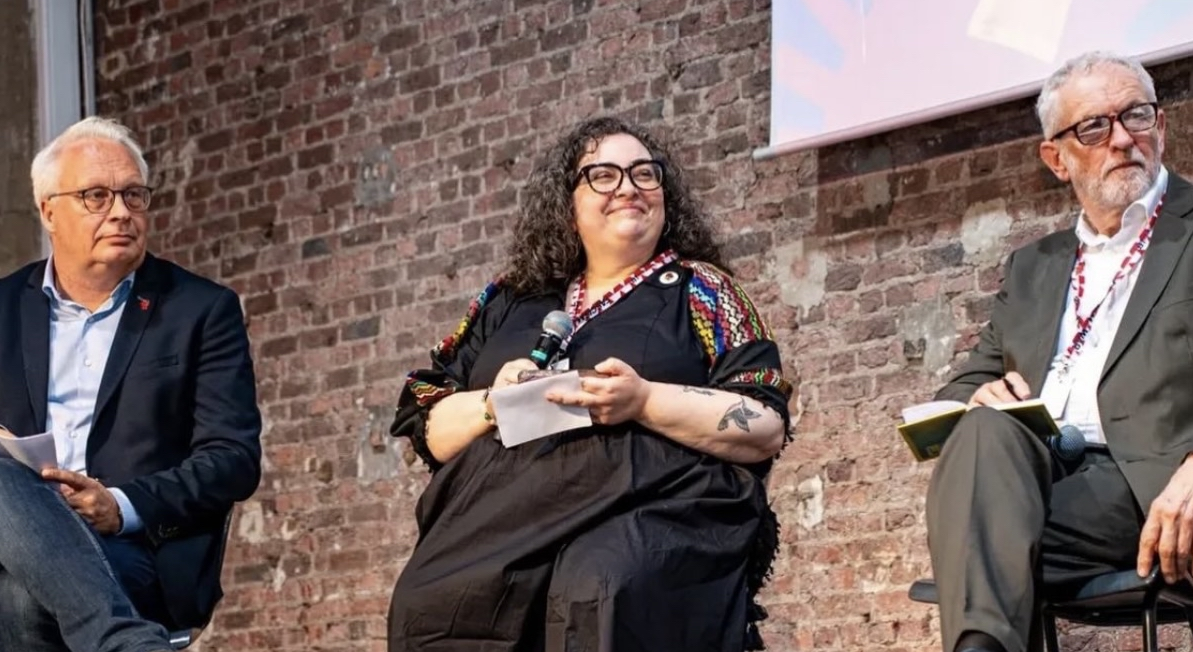
In this interview recorded in June, Red Star member Matt M. debriefs DSA Co-chair Megan R’s recent trip to Belgium where she spoke at the conference of the Party of the European Left and spent a day with the Workers’ Party of Belgium.
This transcript has been edited and condensed for clarity. The full interview is available as a Podcast and on YouTube.
MM: In April, Red Star member and DSA co-chair Megan Romer went to the Party of the European Left conference in Brussels. At this conference, she delivered some remarks on the issues of militarism and austerity, and participated in discussions with other left parties on important political issues facing our movement around the world. Megan's remarks were published in DSA's publication, Democratic Left. She also spent some time with the Workers' Party of Belgium (PTB), had an opportunity to learn the ins and outs of life in the PTB, and see their political strategy and action. PTB and DSA were the subjects of a detailed comparison study organized by the Rosa Luxemburg Stiftung. I'm sitting down with Megan to debrief her experience in Belgium, what she learned from spending time with PTB, and what our similarities and differences can tell us about building a militant revolutionary party.
Megan, thanks for joining us. Let's set the stage. What was the Party of the European Left conference, and what was your role as a guest on behalf of DSA?
MR: It took me a while to figure out how the European left works. These European left umbrella parties exist mostly for European left parties within the EU. There are three that you need to know.
There's the PEL, the Party of the European Left, which is a bunch of parties from a bunch of different countries and also some independent socialist organizations such as the Socialists for a Free Scotland, and a handful that aren’t really parties but more like what we would call an NGO or non-profit. Then there's ELA, which is the European Left Alliance. Its longer name is European Left Alliance for People and the Planet. That's a different coalition of left parties. Then there's the European Left in Parliament, which is the parliamentary bloc that includes everybody who's in a left party or on the left including some independents. The European Left in Parliament encompasses both ELA parties and PEL parties.
So I attended PEL's conference, which is all the parties that are members of the Party of the European Left. Parties send delegates alongside some independents. At the conference, they vote on their program and on their leadership for the next few years. There's also panel discussions, kind of typical left conference, right? Lots of talking heads on stage discussing things, and also lots of good hobnobbing.
I also was able to have lunch with the leaders of the European Left Alliance, which is the other European Left party. Then I was able to do an event at the European Left in Parliament, which included both. It's a Venn diagram with a big circle around it and some little circles. It's complicated.
MM: Kind of a Holy Trinity situation.
MR: It is, yeah. I've been at this for a while and you have to kind of do real diplomacy, right? It's important to not shit talk, but also not to overly praise. Like… "Oh, you're from this country! What do you think about…" because sometimes you might have accidentally just walked into a beef. And we don't want to walk into beefs.
The Party of the European Left Conference was this conference in Brussels. There were 30 or 40 parties represented. I got to meet lots of people, have lots of formal bilaterals where I spoke on behalf of DSA. I do want to make it clear: I was there on behalf of DSA. What we're doing here is a Red Star project, and I have my own analysis. But there, I am everybody's co-chair, and I was happy and very proud to represent DSA.
The Europeans are very excited and motivated to see what we've been able to accomplish. So yeah, formal bilaterals, ripping cigs outside with the Greek delegation, and everything in between.
MM: Awesome. The theme of the convening was ‘Against Austerity and Militarism.’ I see that today, the PTB is doing a nationwide mobilization for welfare, not warfare. There's definitely a theme to the political issues and the approach that these organizations are taking to the problems that are facing the world. Can you say a little bit more about the political issues that were talked about, and how the parties are approaching a lot of the political problems in this conjuncture?
MR: There's some subtext that I kind of picked up on, but it wasn't immediately apparent.
Part of the reason that the European Left Alliance split from the Party of the European Left, at least ostensibly on paper (and overtly) was because of objection to some of the policies of SYRIZA, a member of the Party of the European Left. They had the presidency of Greece during that austerity era and so there's longer-going beef about whether or not that was the right decision, whether or not the party had any control of that, as well as what actually happened. So, I think some of this was the Party of the European Left being like "no, no, no, we're anti-austerity." I don't really think there was ever a question that any party was anti-austerity. It's just… politics are weird, right? And the way we interpret them by reading the newspaper outside of them is also weird.
But yeah, right now we are seeing the war ramping up in Iran, and we’re in year four of the crisis in Gaza, and also year 76 [78] of the crisis in Gaza. Trump is kidnapping presidents of other countries with nobody doing anything about it, and saber-rattling toward Cuba as well as China. So there's that very obvious [connection.] Austerity is connected to international politics. This, to anyone with a socialist analysis, is "of course, those are the same. We're spending money on this, so we can't spend money on that." They come right out and say it, as long as you're listening. So that was the theme for the conference. They got into other things too, including a feminist mini-conference. But it all kind of comes back to austerity and militarism. Like, it's a solid theme because that's the world we live in. That's the primary contradiction.
MM: Was there any special emphasis or special considerations on you, representing the DSA and the United States? In a lot of ways, [the US is] the nerve center of this militarism push, the nexus of a lot of this rearmament, both technologically and financially. The U.S. is part of the global far-right alliance that is reshaping the world right now. Our military firms and the general ruling class structure are this defining force in the world.
MR: Yeah, there was a funny moment. So I spoke on a panel with Peter Mertens from the PTB, Jeremy Corbyn, and the woman who is the ambassador to the Low Countries (Belgium, Luxembourg, Netherlands) from Palestine. I'm extremely honored to be on that panel.
It was very funny – the guy who introduced me, who was a member of the Party of the European Left's youth movement and one of the hosts, basically said something like "America is, you know, the bane of humanity's existence. Anyway, here's an American!" He kind of realized what he was saying [as he said it.] And then it turned out that my speech was basically the same thing.
I do think that sometimes the analysis overemphasizes Trump. That’s true here, that’s true there. I think Trump is the tip of the spear, but he's just the tip of the spear. There's a whole-ass spear, right? Trump can die tomorrow, and there's still the rest of the spear.
MM: No comment on that particular sentiment.
MR: He's an old man. It could happen, right? Things happen.
MM: I think we all have a sense that Trump is a symptom of a rotten system. It's important to share that analysis and make sure that we're operating in concordance with it.
What were some of your big takeaways from the conference? Any highlight experiences that were clarifying? Anything inspiring or otherwise remarkable that happened while you were there?
MR: A few things! The split between the Party of the European Left and the European Left Alliance, they'll both tell you different things about why the split happened, and what preceded the split, and what keeps them apart. But I think the elephant in the room is NATO. The Party of the European Left is very much anti-NATO. Hearing their analysis about what to do about it sounds… not totally dissimilar from doing anything sort of abolitionist-y in the U.S. [People can come to] the correct analysis, but are kind of afraid of it. So even people who are like “yeah, it's bad,” will still ask “but if we just get rid of it, then what happens?”
The Social Democrats have just kind of leaned into being like, “well, we can't get rid of NATO, it's here already, and we're all gonna die if we just get rid of it.” Figuring out how to orient to that is causing a bit of a split. There's also the angle of knowing that NATO's bad, but also that [they feel] we have to protect Ukraine with all our strength and all our money and all our everything. So they think that NATO's good in that case, or something. Selling it [critical analysis of NATO] to the public is difficult.
So the Party of the European Left crew is more directly anti-NATO. It is notable that the European Left Alliance, the Nordic parties are mostly in that one, and the Nordics are closer to Russia, so they have a slightly more "well, NATO's bad, but we need somebody to protect us" attitude. It’s not always said directly, and it’s kinda like trying to read the writing on the wall.
One thing I was actually warned about in advance was "don't talk about Ukraine." And of course, I'm slightly contrarian so I did, in casual settings. In particular, asking things like "where does your party stand on Ukraine?" And for the most part, the analysis I got was similar to our analysis. That it's awful, it's devastating, people are dying at incredible rates still, and also, it's a proxy war for NATO that the U.S. caused by doing proxy NATO shit, So [I ask], the idea that the U.S. has to send a zillion kajillion dollars worth of weapons; when has that ever turned out well for anyone? Every time we send a zillion kajillion dollars worth of weapons, what happens 10 years later? Every season of Blowback is about that.
MM: It's definitely a real conundrum that a lot of the Western left is facing right now. We can understand the dimensions of this problem, but we're really ill-equipped to act or to really challenge our ruling classes in their commitment to this network of proxy wars for global hegemony. Peter Mertens’s most recent book that came out a year or two ago was kind of about this shift in the world order. A lot of the countries in the periphery, the Global South, the exploited nations, however you want to frame it – both their working classes and their ruling classes are looking for a different alignment. That is a world historical shift that we are just beginning to reckon with here. But it's definitely interesting to have that as a background issue, a problem that we are really struggling to confront.
MR: There were some things that surprised me. I thought that [their feelings on] Palestine were a little more complicated over there. My understanding [from] some external party stuff, was that some of the parties waffle a little bit, and were ultimately two-staters or whatever. That is not the sentiment I got in the room. In the room, it was “Free Palestine” all day. So that was good to see. I'm curious; I think they struggle to thread that needle in Europe, just like we do here. The Holocaust happened in their backyards, and was… perpetrated by many of their grandparents. We also have a Holocaust perpetrated by many of our grandparents in the U.S., so we’re both figuring out how to reconcile that. They struggle more than we do, especially in Germany, with attacks like “oh, you're for Free Palestine, then you must be antisemitic, right?” That sort of un-nuanced [analysis,] that there are only two things, free Palestine or safety for Jewish people, and you have to pick only one. We think that’s absolutely ridiculous, but it's [analysis] that sells easily in the media. It tugs on your heartstrings, and those overly simplified analyses do well in the media. It’s just like every other piece of what we're saying. [Same as] when people say ‘oh, you want to get rid of the police? Okay, well what about when somebody breaks into your house and kills you?’
MM: Those are some very deep political challenges that our movement is currently struggling to overcome, certainly in the context of an ascendant, neoliberal, neo-fascist right that is cleaning our clocks daily. It’s a tough situation.
I'm wondering if you can say a little bit more about PTB's role as the country host, not necessarily the organizational sponsors.
MR: So, they're a member of the Party of the European Left, though they were not actually a member, as I understand it, until the European Left Alliance broke off. They decided that with the split, they wanted to join one of the parties. I didn't realize that, I thought they were a long-time member. It was on their turf, so of course there were lots of folks around, they probably had a bigger presence than anybody else. But this was not a huge conference, it was a couple hundred people, a few hundred people, it was not thousands.
Peter Mertens was there. He's extremely charismatic, he’s about the most charismatic guy you've ever met, but also extremely brilliant. He's just very present in a room. But also lots of their militants and folks who do their international coordination and things like that. And as much as Peter Martins has a little star power, they're very much a party, and it's interesting – they're like, ‘yeah, no, that guy's great in front of people, but… He's one of us.’
MM: PTB came to DSA's National Convention last year and was part of our intra-Left discussion event, which I thought was really interesting. They were paired up with us in that report that the Rosa Luxembourg Stiftung put together, comparing the very divergent party structures and party histories between the two of us. I remember from that discussion hearing about their three-tiered structure, their cell formations, and finding their general ideological outlook on party-building to be really interesting. Did you get to spend some time with them? Who did you spend time with? How was that for you?
MR: I'm completely ready to move to some little town in Brussels and start my 12-person cell, and leave all this nonsense behind. (No, I love this nonsense.) But it is very appealing, because I really love the way they're structured out of the way they think about each other and about the party. I spent the day after the conference in Antwerp, which is 40 minutes by train north of Brussels. I got to spend the day with some local party militants, folks who just are on the ground doing the thing. I got to do a bunch of stuff.
The day started with a worker's tour of the Antwerp train station. They have a party militant who is a tour guide for a living. When you go to Europe, there are all these incredible, extraordinary buildings. In Belgium in particular, because we all know the history of the Congo and such, you can really see that this is built on the backs of the Global South, in a very present way. The king's face is on stuff, King Leopold II's face is on stuff. You know what that guy did, and they're not shy about it. There is some reckoning with how bad it was. So the Antwerp train station is just extremely gorgeous, gilded, beautiful marble blah blah blah. To be able to take a tour with somebody who's a militant leftist to say, “okay, so this is where the worker died and they didn't put up a plaque. And this is who was exploited to dig up this marble.” It's still very beautiful, but it gives that context of what it means to exploit.
There are lefty tours in most big cities. There's a Marx in Brussels tour, because that's where he wrote the Communist Manifesto, and you can walk around – there's his house, there's the restaurant where he wrote the manifesto, whatever. We need a thing where you actually talk about the famous thing and who the workers were. Somebody do the Brooklyn Bridge, there's some fascinating stuff.
So we did that, but [we were with] a dozen local militants, most of whom were middle-aged women. I was like, ‘hello, friends, associates, people of my ilk.’ We were talking about our teenagers. I also got to ride up on the train with a former congressman and a press secretary from the Japanese Communist Party. That was a fun little trio of visitors. But we did the train station tour, then we went to lunch, then we went to the PTB house. It's a four-story city block place. There's a meeting room downstairs, a bunch of offices. Peter Mertens’s office, where he records his podcast, is there. I recorded a podcast episode with him, which you can watch on YouTube.
Then some of the militants took me to dinner. They're very good about making sure there's time to sit down and eat a meal in Europe. In the US, we're like, let's just grab gas station sushi. They're like, no, we're gonna sit down for an hour. Even the leftists, right? Even the radicals are like, ‘no, no, no, we're civilized here. We sit down for a meal.’
Then we went to a cross-organizational demonstration for Palestine, which is a demonstration they've been doing every week for like a year and a half. It was in front of the Opera House, another one of those moments where you're like, yeah, the exploitation of the third world, it creates really beautiful things, and also extreme misery. I wonder if there's a way we could… not have it be that unbalanced. Talking to the PTB folks about how they do these cross-organizational things was really interesting. They have some of the same struggles with coalition work that we do, and some of the same opportunities and joy in coalitional work.
One thing that happened is that a man walked over to me and handed me a bag of chocolates from one of their coalition orgs. Apparently they sell these chocolates, and it raises money for Cuba. Here [in the U.S.] we have our kids selling chocolate to raise money so they can have arts programs in school. There, they actually have the arts programs in school, so they sell chocolates [for Cuba]. It's the same sort of stuff we fundraise for, sending medical supplies, mostly.
The fun thing about sitting down for a meal is you can sit there and just ask a zillion questions in a row. Of course, they also have questions, and I'm like, ugh, who cares about Trump? Let's talk about your thing. But it's really an honor to be able to brag about DSA in those settings. Everyone's very impressed and shocked that there was a left movement this big in the U.S. It can't really be overstated how much the rest of the world sees us as the great Satan.
MM: Correct. It just means that it's so important for us to keep doing the work that we do, and keep trying to carve out a place for a politics of dignity and survival and global justice and socialism, here where we are. What sort of things were you able to ask about? What were some of the questions that you had, and what did you learn?
MR: Most of my understanding of the PTB had come from that report. I’d read a couple articles here and there in Jacobin and in other places, but that was my understanding of their structure. So the first thing I did was, like, ‘everybody read that article, right? Everybody read the report, right?’ And some of them had, some hadn't. It's very funny because when I read the report, I was like, ‘damn, that other party we're getting compared to sounds cool.’ And they kind of felt the same, but in reverse, which is really funny. But I had lots of questions.
One of the questions I had was about structure, I was really curious about how this works with the cells. Basically, it maxes out at ten. That's your base group, is what it's called. You and your base group are a family, you meet very regularly, for a long time. You talk about stuff. And then the base group leads, I think they're called coaches, the coaches report upward. The central committee is in extremely close contact with the coaches, so when something happens, whatever it is, they very quickly try to get their base groups to discuss it, and then try to synthesize an analysis of how folks are feeling on the ground. I was like, that sounds so hard, because one of the things we struggle with so much in DSA is communication up and down, and side to side, too. How are we getting information from one place to the next? And getting information from each other to each other is the core of what they're doing.
They have a much tighter political line, obviously. I believe they refer to themselves as Marxist-Leninists. You have to be a communist to be a member, when you're joining, you say, ‘I am these things, and I believe these things.’
As is the case with many communist parties, you're not allowed to have factions. I actually asked at dinner, obviously, factions sort of organically form, right? People form friend groups, or whatever. And they were like, ‘No. Absolutely not. You do not.’ And I was like, nobody calls each other [to say,] ‘What is this? What's going on? How are we gonna organize against it?’ They're like, ‘no! If you have a problem with something that's going on, you come to a meeting, and you debate it politically.’ That's how it works. If you don't like something at the party, you go to a meeting and you debate it, and you discuss it with your comrades, as comrades. Of course you have friends, but we're not here to be friends, we're here to be comrades. We're in the struggle together. That sounds like a very far-distant future… It just feels very different and very distant, the idea that you actually just make it politics and you bring it back, and you don't turn it into proxy battles.
I was curious about the size of the base groups. I've been a crank about this for a while – I don't think you can actually organize with more than, like, 100 people successfully. We have these really big chapters. How are you successfully organizing with all these people if you're not in some sort of micro-unit? They believe that, much more strictly than I do. My limit’s 100, maybe 200. Their [cell size] is like, 10, and when it gets to 10 or 12, it's much better to have two groups of six than one group of 12. I thought that was interesting, because you need a lot of time to discuss, I still wonder, do you get enough diversity of opinion? Do you get enough diversity of experience in a group?
Like I said, I want to move to Belgium and try it. I'll be a flower seller with a little bike with my flowers in it. It's just such a different way of constructing [a party.] I'm sure having a tighter political line makes that much easier, right? If you're really doing a big tent mass party, you need to be incorporating a pretty broad range of tendencies, and six [people] might not do that.
MM: It's a very different structure, because those are your militants, right? Your groups of six to 12 are your totally bought-in cadre, but they also have a broader supporter group, and they have allied organizations, so there are lots of ways for people to support the party, even if they are not part of that upper layer. I remember reading in one of the Jacobin articles about the party that they went from 800 hyper-militants in 2008 or so to 24,000 supporters. That's a huge transformation of their organization. The degree of getting people bought into the line through these discussions, doing democratic centralism through convincing and not necessarily just doing commandism through the central committee, these are things that help give the line life in a way that I think is important for us to consider.
One thing that stood out to me is that there's a rigorous vetting and recruiting process for party militants in PTB, versus what is described in DSA as a ‘voluntocracy.’ That's a huge distinction for us to pore over when we're thinking about turning DSA into an organization that's capable of generating a movement of millions of people. Is it through pulling a million people in and expecting them to learn how to lead together, or is it through developing a leadership layer that can understand the situation and grow its understanding outward through action? These are really deep distinctions that are interesting for us to pore over and think about how we can learn and adapt.
What else did you learn about PTB, their goals, their theory of change, and any obstacles that come across in their recent 10 to 15 year turn?
MR: They have some similar struggles. Their membership, like ours, is downwardly mobile, disproportionately educated and white compared to the general population. They do skew older – DSA is the only org where everybody’s so young. That is not the case anywhere else.
There are lots of things we could attribute it to. They usually have childcare in European countries. I'm in my 40s, I was relatively young when I had my kid, but It's not uncommon for somebody in their early 40s to have elementary school children. How do you do anything when you have elementary school children? But they have childcare in their countries, which actually makes a big difference. Different countries have different levels of coverage and such, but we have none. None whatsoever.
In Global South left parties, they have cultural care for children in a way that we don't. You just bring your kids, and sometimes they make a noise. Here, children must be separated from the group, but also, we do not provide you any support for that. I don't think that's the attitude in DSA, but it is something that is built into our culture. We struggle to hear the noise of children in a group setting and continue to function. Speaking of which, my child is making noise in the kitchen right now. Malcolm, quiet!
They had expressed that some younger people have a hard time getting through the full cadrefication training process. It's a lot of hours of reading, it's a lot of hours of study, it's a lot of discussion. You have to come out to things, you have to be reliable and show up to things. So, that is a shared struggle.
They have been seeing more success with their parliamentary political program. For a long time, PTB did not do elections. Back when they were still small, they were working to mostly embed themselves in the labor movement. Some of the older militants in the party told me, ‘I worked in a factory because that was what I was told to do.’ A lot of that industrialization is just more difficult as we deindustrialize the country in general. The reason you have to be a teacher or a nurse anymore is because there is no factory. It's a strategic industry, but also, what factory are you gonna work in?
I'm being hovered over now by the child. He's hovering.
MM: Malcolm is standing guard against revisionism as we talk about European parliamentary parties. We appreciate the vigilance.
MR: Exactly. No one has more opinions on the European left than my 16-year-old.
MM: Speaking of this parliamentary turn, in the Jacobin interview with Raoul Hedebouw, he talks about being in Parliament, but not finding any power there. That's an issue that we are struggling to confront in DSA – as we gain these electoral successes, we put people in city councils and state legislatures and Congress and executive offices – that the office alone is not a sufficient engine of class power to drive the social transformations that we’re hoping for. I'm curious if you talked about their parliamentary strategy, how they think about the work of governing. Particularly when they're a small party that's always going to be a minority faction in the parliament.
MR: Not always. Eventually, we win, right?
MM: Okay, fair enough.
Not as much [time to talk about parliamentary strategy] as I would have liked to. I only had a single day on my PTB intensive. But I do get to go back for their big festival. They do this music and politics festival – music, arts, politics, books – called ManiFiesta. I'm going there in September, and I look forward to asking a zillion more questions.
They are very agitational toward pretty much everybody, including the Social Democrats. You see a mix of this in Europe on the left a bit, how agitational they are against the Social Democrats. It's important to note that the Social Democrats are barely social Democrats anymore. They're significantly to the right of what a Social Democrat would have been in the 50s, 60s, 70s. But because the U.S. is so privatized, our politicians don't have the same amount of power, because the market has so much of the power. They're a little less privatized. It depends on the country.
Sweden, interestingly, is the most privatized of the European countries. In the US, in the popular liberal imagination, Sweden is this beautiful, perfect place. It's heavily privatized and getting worse, including things like the train system. They're privatizing the trains, which is crazy. I'm like, ‘Don't do it!’ But when you privatize something, you lose control. It becomes the market’s. It's not the elected body’s to control anymore. In the US, we've privatized everything. Including the education system, the public health system, hospitals…
MM: We just watched our aerospace industry get privatized to the tune of trillions of dollars, right? It's crazy! It's crazy, but…
MR: It's crazy.
MM: Even though it's so thorough, there are so many more layers of financialization and speculation to keep throwing on top of this totally unstable house of cards. But that's beside the point. Back to the question of governing in the era of austerity and privatization.
MR: Yeah, so when you are an elected official, you probably have a little more power in a country that's less privatized, in a country that's somewhere in the realm of being closer to a social democracy than our full-on corporatocracy.
People will call you and me anti-electoral. We’re certainly not. It's just the question of whether the only way to win power is through elections. You can fill every single electable office in the U.S. with a socialist, and you still don't have socialism, because it's so heavily private. There's no socialism button, there's no socialism bill. They’re a little closer in Europe, but my understanding is that the PTB uses political office to be quite agitational. Their purpose of winning an office is not necessarily to win reforms and brings up the question of “what is the point of reforms?”
Is the point of reforms to be agitational? Is it to show people, like, “hey, this is the sort of thing you can get if you elect more people to office”, or is it to make people's lives a little better so they have a little more time to organize, or is it something else? There are a bunch of different questions about it. [PTB] seem less committed to just passing a bunch of stuff, and more committed to using the bully pulpit. My understanding is not that they make a point of doing a bad job [in office], right? [PTB electeds] still attempt to be functional, good legislators, but the point does not seem to be “We will legislate our way to socialism” by any stretch.
And you see our electeds do this too: lots of their electeds are openly agitational in the house, and also at street protests getting arrested and using that as an agitational opportunity. But the point is agitation, not legislation. That is my understanding.
MM: Thinking more in this comparison mode about the problems that we've had in DSA – our organizing challenges versus the challenges of this tight ML, DemCent formation. You've done a lot of interfacing with DSA chapter leaders, you've visited lots of people, met with lots of our comrades, problem-solved on a lot of problems, and tried to help chapters of DSA become these engines of political activity and resistance. What are some of the challenges that you've seen in DSA chapters that are similar or different from the ones that you saw with the PTB?
MR: Ultimately, one of our biggest challenges is just convincing people that this is where they should spend their time. It’s hard! I think sometimes we think about it in terms of “here's why you should be in DSA and not some other organization”. But really, we're not competing with any other organizations, we're competing with Netflix.
And rightfully so! Modern life is hard and sucks, and having a little escape at the end of your day feels really good! Spending another four hours, or eight hours, or whatever a week doing grinding political organizing [where] change is very slow and we win things and they get taken away is hard! It's hard to convince people to do that.
I think there's a balance here: you need to figure out how to make it feel good, and you need to figure out how to make it feel good honestly. That's a challenge. You need to make it feel like ‘I am actually being involved in making real change and moving us closer to stateless, classless moneyless society. How have I contributed to that?’ Doing that without lying to yourself about everything being a win is hard.
MM: I'm thinking about the total transformation of values and discipline and personal experience of struggle required to go from being a person that's working eight, 10, 12 hours at my shit job, to spending the last two hours of my day in a political line struggle over something really shitty that happened in the world, versus I'm gonna go watch The Pitt for an hour. It's a big change, and not to essentialize or stereotype Americans, but in America's culture of convenience and plenty, it's a choice that we're not accustomed to making on a daily basis. Did you get a sense of how people get bought into that kind of life in the party? Did you get a sense of what feels meaningful and rewarding about party work in PTB?
MR: I actually think the smaller cell structure makes it feel a little bit like a family. You feel like you're this very important part of a fairly small structure. Having this very close-knit touchpoint as opposed to being one of 300 people with a voting card at a meeting, or just a person who gets called to phonebank or knock doors sometimes, you’re really part of the structure.
I was skeptical about [that degree of structure]. It seems like so much work to do the admin side of organizing [that it would get in the way of] the class-facing side of organizing. But it does seem to create more serious buy-in because we are social creatures, and we feel like a part of this unit and we feel like it matters. And this unit becomes a [major part of your life.] If you get your appendix out, somebody from your cell brings you dinner. Those kinds of basic care things do help.
Chapter leaders ask me all the time: how do you avoid burnout? How do you avoid burnout? How do you avoid burnout? Well, first of all, I don't. I am but a normal mortal, and sometimes I lay on the floor and cry. But the thing that helps me avoid burnout is remembering that my big struggle is [usually that] somebody was mean to me on Twitter and mischaracterized something I said, and turned it into a proxy battle for some third thing. But the left, just in the United States, has faced down the National Guard and the Pinkertons. We’ve been murdered by the FBI. Times have been worse than somebody calling me fat on Twitter. I try to ground myself in our history and put things in perspective.
Actually, that’s the question I want to ask them: how do [they] ground [themselves] in the left history? I don’t know a lot about the left history of [the Low Countries], outside of resistance movements in World War II. I don’t know when unions got formed, I assume around the same time they formed everywhere.
MM: In terms of grounding these organizing relationships and organizing life in the impacts we're having: These cells are militants and not just supporters. Are they responsible for doing party work in other spheres of their life as well? The social reproduction of caring for each other and supporting each other, and supporting people in your life, but also the production side, where your economic life is in the workplace, in other areas of exchange. Were those relationships key to forming these cells as well?
MR: Cells can be formed in a few different ways. They can be geographical, people within a a neighborhood, within a couple blocks of each other. They can also be a workplace cell, that’s common. I think there are some alternatives, you can propose something. I could see cells being formed between parents who all of their children attend the same school, [situations] where you have this common thing that’s holding you together. The cells are definitely not just six people shoved through the randomizer. It’s six to eight people who share an immediate neighborhood, which usually indicates they’re going to be in a similar economic bracket, have the same city councillor. There are university level cells. Who do you hate? Your boss, your landlord, or your mayor? One of those people [defines] who your cell is.
MM: Tying this back to the question of fatigue in DSA and making sure that we’ve still got the the juice for for the struggle, do you think that the moments of upheaval where the left was really fighting back are not just a thing of the past, but a thing of the present? People are organizing street watches, in solidarity with Hunger Strikers at ICE facilities, around cuts to Medicaid, cuts to trans healthcare, there's a huge amount of struggle that's going on right now. Is there a way that we can have DSA really feel like a home base for that kind of social-political activity in a way that this this party structurein Belgium is a similar kind of backbone?
MR: I hope so. I want people to feel like DSA is the place. We throw around the word comrade a lot, but it actually means something? It means something pretty serious. Calling someone “comrade” means that you're in the struggle together. It's both an expectation and an honorific to call somebody a comrade.
So how do we build that same amount of buy-in? It is different to do it as a cross-tenancy mass party, because there will always be internal tensions. The trick is to make these tensions political, just political. Everyone gets so mean? I don't know how to make the meanness stop. It’s easier to fight mean, right? It's easier to call somebody dumb, it's easier to call somebody lazy, it's easier to call somebody uncommitted, it's easier to call somebody unserious. Those are all easier than actually analyzing and figuring out why their politics are different from yours, and how you can either synthesize them or just come to a conclusion.
I think that is easier in a line organization. I also think there are things that are harder in a line organization. It’s inherently probably going to be a lot smaller. So when you're actually trying to do mass movement things it will be more difficult. A line organization will be less appealing to lots of people. There are benefits and drawbacks to both, obviously.
The ideal thing would be for everybody to just agree with me on everything, and then we could all be in one big mass line org.
MM: We'll start working on that proposal for ‘27 convention. But in a similar vein, DSA has spent a lot of our time in our modern iteration, the last 10 years, trying to articulate what it means to be a party. There's virtual consensus in DSA – very few organized currents within DSA would disagree that we should be trying to build or become a workers' party. But this consensus verbiage doesn't necessarily bring us closer to aligning in practice. What was your impression of PTB as a party? You mentioned that that was something you definitely felt.
MR: Part [of the difference] is that in the U.S., the system makes it very hard to have a party in the same way you can have in a parliamentary system. Everybody wants to break from the Democrats immediately. I don't really care either way. But I think it's very cart before the horse, and it also ignores certain aspects of U.S. law. If we have a Democratic Socialists of America ballot line, anybody can run on it. We don't control it. [In Belgium,] the parties control their line.
But really, all those sort of details of the U.S. system are not really relevant to the idea of building a party as this coherent, cohesive unit. And that to me is the much more interesting question. For example, we talk about electoral discipline, and then we look out in the general public for people to run for office. PTB doesn’t have a problem with electoral discipline because their party members are who they run for office. Those people are already bought in. They've already gone through the program. It’s not even a question of discipline. [Focusing on that aspect] is a weird framing of the question.
In Red Star we talk about how [discipline] is that you have, not something that you do. How do you get people to feel disciplined to this party? We’re very far from that. But not in all cases! Increasingly, we have electeds who are very committed to DSA. We are not just their political home: they are ride-or-die’s for DSA, which I think does make a difference. The fact that that is still something that we're [really impressed] about means we've got a ways to go.
When we say becoming a party, we're always talking about structure and about rules and bylaws, and about all these discrete components that become a party. We say “oh we’re gonna have to write a better program and then we’ll be closer to a party.” [That’s not going to work] if everybody is threatening to split every 10 minutes over something somebody else said. We won’t be able to form a party if we aren’t able to have collective political discussion without it turning into [mean posts on Twitter.]
I think we underestimate how much becoming a party is vibes-based, for lack of a better word. How much is just about us being committed to each other and the movement. It’s not vibes, that’s not right. I feel like we think we’re going to form a party with the right bylaws, or the right program, or the right words but [we are not addressing] the ability to have generative, productive political conflict in a way that [honors and meets the expectations of calling each other comrades.] It should be an honor to debate you as my comrade. It’s an honor to hear your opinions and work through this together. I’m trying to demonstrate that personally and build it up that way. It can work but it can also be fragile and it’s hard. How do you build a [collective spirit when individualism] is baked so deeply into our modern DNA?
MM: One thing that we've said a lot in Red Star over our history is that the party cannot be declared, it can only be built. That's something to really turn over in our minds, that simply calling ourselves something else does not fundamentally change how we act, how we struggle, how we approach the political problem in front of us. That's something to bear in mind as we keep trying to move towards a situation where DSA as an organization has a lot of tools at its disposal for waging class struggle. We just talked about how structure isn't really the thing, but do you have any thoughts about how DSA could develop in ways that make us more party-like in a PTB sense?
MR: Structure is also extremely important, and I don't want anybody to take away that I think that it's not. But some of it is cultural and we need to work on developing a culture of constructive criticism, of generative political conflict. If we disagree on something politically, we should bring it to the meeting and debate it right there. We struggle to just center the political conflict as politics. How can we build structure for that? You also have to have meetings in order to have political conflict in meetings. The meetings have to be structured in such a way that there is space and room for debate.
We need to think more about democracy. We know democracy is not just voting. So what does people’s whole-process democracy look like in the context of our organization? How do we do better about having roundtables, where we can actually pull some political questions? How do we read together? How do we think about the strategies of how we're going to approach the shop floor? I'm sure at least one person watching this is asking: why don't you have any answers? To me, the most important thing is always to figure out the right question first before you move before you try to find the answers. I think we're still in the process of figuring out exactly what the right questions are.
But we need to [create more connections] from our good political debates to the work we’re actually doing. I think sometimes we pass things, or we say things, and then it doesn't actually reflect [what we are actually doing.] I don't want to be statementizers. It can be good to write a statement collectively. It means that you're clarifying your politics collectively. Then what?
I do think smaller units is an interesting idea. I would love to see a chapter experiment with this idea. What does a base group look like? What does a core group look like? I think that would be such a cool, fun experiment. I'd like to see more experimentation with that kind of stuff. We have almost 250 chapters now, so we have some space to experiment. They are the laboratories of democracy, let’s crank up the Erlenmeyer flasks and see what can bubble out of it.
MM: One contradiction to the way that we think about politics in DSA and in the U.S. more generally is that our structure in DSA is really built around government administrative units. We have county level, we have city level, we have things apportioned by zip code. That leads to some very big organizations that have maybe not the deepest roots in the communities that they're supposed to be responsible to. And there's this bigger question of responsibility and accountability.
We are not just a society of any amorphous form, we are a socialist organization with socialist goals. We have historical tasks that have not just a moral, but an economic and social debt in connection with the struggles of oppressed people around the world. That's not an abstract thing. That's a real problem that we've got to reckon with and resolve. So how can we make not just these small groups that are more able to synthesize political conditions in whatever they're doing, but also root our work in the historical tasks that are in front of us? Those are important things to keep on our minds.
Any other thoughts about your experience with PTB, this conference, the shared struggles that the left is facing at this moment, and how we can keep at front of mind as we approach our political work at this conjuncture?
MR: We definitely all need each other. In the past I have written off the European left, like, who cares, right? I care about the Global South. I think the European left is very valuable to us. They are organizing in closer conditions to ours than anybody else. Nobody's got conditions like the U.S., but it's closer. They have potential to do things like close U.S. Army bases. If all the E.U. state governments refused to deal with the U.S.'s embargo on Cuba, it would change. They vote in the U.N., but [the U.N.] don't actually do anything. What does that look like? What if they slap tariffs on us?
They actually have some power to shove at us a little bit. We're still the biggest, we're still the meanest, we're still the whatever, but there is some space for them to kick one of the legs of the stool out, while then making space for our comrades in the Global South to actually win. Because ultimately, I think that's where the win comes from. How can we make it easier for them to do that, is largely our goal.
But they are in conditions like we have in Europe. Similarly, increasingly militaristic, increasingly neoliberal. How do they fight back against it? Some of it looks different. Parliamentary systems look different than this two-party system that we have. But the act of building a party, the act of building this collective unit, the political instrument, there's plenty we can learn from.
One thing that does stand out to me about PTB in particular. I mentioned earlier that I'm going back from ManiFiesta in September. They're very good at incorporating fun and joy and jokes and humor and good feeling. I think that helps, especially being rather sternly Marxist-Leninist. It's important to add that element of the joy of connectivity. The world we're trying to build for is not this gray breadline socialism. It's this vibrant world where we have room to express ourselves and live to our fullest human potential. I think they're good at that. I think DSA should have a festival, is what I'm trying to say.
MM: Comrade co-chair, thank you so much. To find more analysis from Red Star, visit our website, find us on social media, and feel free to reach out to us if you are a DSA member or communist activist to see if we are in your area.
MR: Solidarity.